
 English
 Korean



Phthalocyanine Blue Preparation Guide for PE and PP
Global masterbatch demand reached USD 6.88 billion in 2024 and is projected to grow at a 6.07% CAGR through 2032, pushed by packaging, automotive, and consumer applications (Data Bridge Market Research, 2025). Underneath that growth, the conversation among processors has shifted. It is no longer only about which pigment delivers the right shade; it is about which dosage form delivers that shade repeatably on a running line.
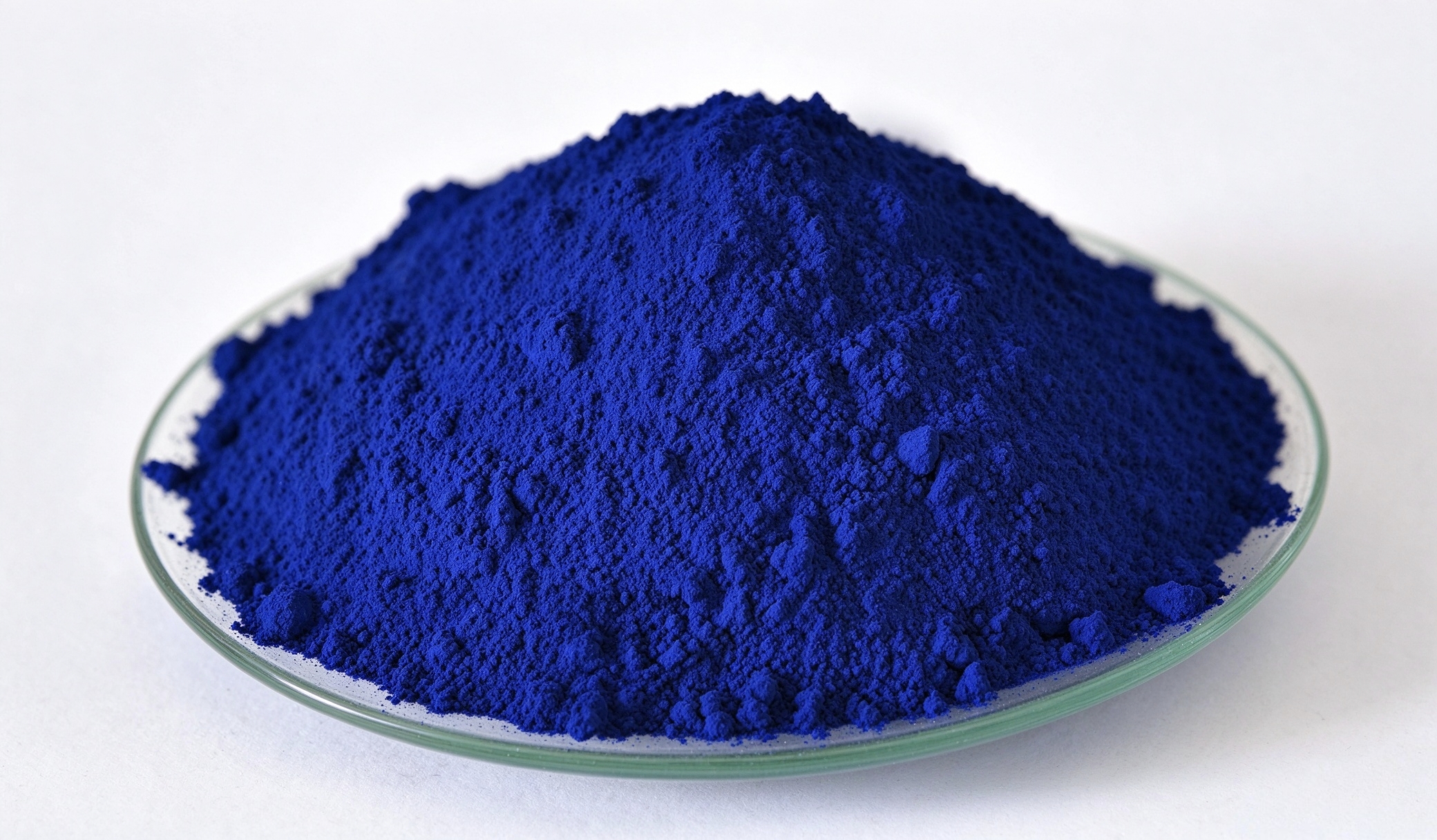
Eupolen PE Blue 69-1501 sits squarely in that discussion. It is a Sun Chemical pigment preparation built on alpha-modified copper phthalocyanine (PB 15:1), originally developed under the BASF Colors & Effects portfolio and transferred to Sun Chemical within the DIC Group after the 2021 acquisition of BASF's pigments business. Based on our analysis of sourcing inquiries over recent years, blue remains the color where complaints concentrate: specks, batch drift, and warped lids.
This article walks through the datasheet numbers that actually decide whether this blue powder fits your line — dosage conversion, colorimetric behavior, warping behavior, and resin compatibility limits — so the selection decision rests on data rather than on shade chips alone.
What a Fully Dispersed Mono-Pigment Preparation Changes on the Floor
A powder pigment and a pigment preparation differ in two places: metering and dispersion. Eupolen PE Blue 69-1501 is a fully dispersed phthalocyanine blue pigment preparation containing roughly 50% pigment and 50% low-melting carrier, delivered as a low-dusting powder with particles below 1 mm (Sun Chemical technical datasheet).
| Parameter | Value or description |
|---|---|
| Colour Index | P.B. 15:1 (74160), alpha-modified Cu-phthalocyanine |
| Pigment content | ~50%, adjusted on colour strength |
| Physical form | Low-dusting powder, < 1 mm |
| Bulk density / bulk volume | 0.55 kg/L / 1.8 L/kg |
| Density | 1 g/cm³ |
| Carrier melting range | 60–120 °C |
| Full-shade dosage in HDPE | 0.20% preparation ≈ 0.10% powder pigment |
For a production floor, that structure changes three things:
Metering tolerance widens. Full shade needs only 0.20% of preparation. At such low addition rates, weighing errors are magnified, so a free-flowing, low-dusting form helps gravimetric dosing units stay consistent.
Dust and cross-contamination drop. Low-dusting powder means less airborne pigment during manual charging or pneumatic transfer, shorter changeover and purging times, and fewer speck defects on light-colored parts running in shared lines.
Dispersion work moves upstream. The pigment arrives pre-wetted in a compatible carrier, so the screw only performs distributive mixing. Undispersed specks and color streaks become far less likely.
From our experience compounding and coloring polyolefins alongside our sister plant, the 60–120 °C carrier melting range is the most misread figure on the datasheet. It describes when the carrier softens so the preparation can flow early in the barrel — it is not a processing-temperature ceiling. Barrel temperatures should still be set for the base resin, not for the preparation.
Warping: Why Crystal Form Matters More Than Shade in Blue PE Parts
Warping complaints on blue parts are rarely a color problem. They are a crystal-form problem. Copper phthalocyanine exists in two commercially relevant polymorphs: alpha (PB 15:1) and beta (PB 15:3). The beta form differs in hue and strength, and it influences the crystallization of polyethylene and polypropylene more strongly. Large flat parts — crates, pallets, thin-wall container lids — can lift at the edges or go out-of-flat diagonally. Stabilized alpha pigments such as PB 15:1 substantially reduce this tendency.
The datasheet for Eupolen PE Blue 69-1501 states Warping: None in HDPE, at both full shade and 1/3 reduction against 1.0% TiO2. In our injection molding projects, "no warping" holds on the part only if three conditions hold as well:
Wall thickness stays reasonably uniform, and gate position or runner design is not drastically changed.
Mold temperature and cooling time are set for the base resin — not shortened to recover cycle time after a color change.
Dosage stays within the recommended range; overloading the preparation alters melt shrinkage behavior.
If any of these three conditions fails, even a non-warping blue pigment for polyolefins can produce a warped part. Diagnosing the variable before switching material is almost always cheaper than the switch itself.
Two practical notes round out the picture. First, differential shrinkage is what the eye reads as warping: pigment particles act as crystallization nucleation sites, so the effect grows with pigment loading and with highly oriented flow in thin walls. From our experience supplying logistics and turnover-box producers, flatness disputes almost always pair with a recent cycle-time reduction. Second, if warping were not a constraint, a beta-form PB 15:3 would offer a greener, stronger blue at lower cost per kilo of color — the alpha grade is chosen precisely because dimension stability outranks strength on large parts. Making that trade-off consciously, per application, is what separates a color specification from a color guess.
Reading the Color Data: Full Shade and 1/3 Reduction Are Different Questions
The two colorimetric datasets in the datasheet answer different questions, and confusing them is the most common cause of rejected color matching. Full shade describes 0.20% preparation over white. The 1/3 ISD dataset describes 0.20% preparation combined with 1.0% TiO2 in HDPE.
| Color value | Full shade over white | 1/3 ISD reduction |
|---|---|---|
| L* | 35.9 | 58.4 |
| a* | -6.2 | -21.4 |
| b* | -33.0 | -36.4 |
| C* | 33.6 | 42.2 |
| h* | 259.4 | 239.6 |
The hue angle moves from 259.4 to 239.6 after reduction — roughly 20 degrees toward green — while chroma rises. This is not a defect. It is the intrinsic behavior of alpha copper phthalocyanine: the more white it sees, the greener and cleaner it appears.
Two field rules follow. For dark and master-color orders, judge against full-shade data. For light tints, pearl bases, and off-white blends, judge against reduction data; matching a light blue against full-shade figures almost always lands reddish-purple. Second, fix the acceptance criterion before sampling: a ΔE00 limit agreed in writing beats a subjective "looks close" conversation. Note that the same preparation measured on different machines or mold temperatures will already show scatter, so the measurement conditions belong in the specification, not just the limit.
Sampling practice decides whether the numbers survive contact with production. Judge plaques molded on the production press, in the production resin lot, with the production TiO2 grade — a lab plaque from a different shear history can shift hue by more than the tolerance you are defending. Keep the melt temperature and back pressure identical between approval and release runs, and archive a physical retained sample plus its Lab* values for every approved batch. Where the application demands polyolefin coloring across several plants, adding a lot-to-lot drift clause to the supply specification costs little at signing and saves weeks of dispute later.
Resin Suitability: Where the Product Works, Where It Needs Reformulation
The same blue pigment preparation behaves very differently across resins. Sun Chemical grades the medium suitability in three tiers, and in selection work this table deserves more attention than the color data.
| Suitability | Resins | Practical guidance |
|---|---|---|
| Suitable | PP, LLDPE/LDPE, HDPE, PP fibers | Use at recommended dosage; covers injection molding, blow molding, and PP spinning |
| Potentially suitable | ABS, PS, HIPS, SAN, PA 6, PA 6 fibers, PUR | Validate compatibility and shade first; check carrier versus processing temperature |
| Not recommended | PVC, PC, PET, PMMA, PES fibers, rubber | Processing temperature or carrier compatibility does not match; choose another form |
The engineering-thermoplastic boundary deserves emphasis. PC and PMMA are typically processed at 280–300 °C and PET runs hotter, while this preparation's carrier melts at 60–120 °C. Introducing it directly into those systems risks shade drift and yellowing. PVC operates cooler but brings a different stabilizer system and shear history, and it is likewise outside the recommendation.
If the part is a PC/ABS alloy, PA, PBT, or PPS grade, the practical route is to rebuild the blue into a blue powder for polymer coloring matched to that resin — as a masterbatch or a compounded color. Our sister company, Qingdao Primetech Plastics, handles modification and color compounding across PC, ABS, PP, PA, PBT, PPS, PPA, and PETG, including toughening, filling, alloying, flame retardancy, and custom coloring, with standard colors and basic modifications sampled in 3 days and delivered in 7. Qingdao Prime Union Trade Co., Ltd., with more than twenty years in raw material distribution as an authorized distributor for Chimei, SABIC, Hanwha Total, and Hyosung, supports the resin side through general trade, processing trade, and bonded transfer — so the resin selection, color sampling, and batch approval can be run on one track instead of three.
Conclusion
Consistent blue parts come from aligning four things: dosage form, crystal form, addition rate, and resin compatibility. Confirm the pigment content and the powder-equivalent dosage, verify the shade under reduction conditions, respect the suitability table, and lock acceptance with production-consistent samples and a written ΔE00 criterion. For procurement and process teams, treat the technical datasheet as the shared language of qualification rather than a sales document. As masterbatch demand keeps compounding at roughly 6% annually, the processors who win on color will be those who convert datasheet numbers into written acceptance criteria before the first production run.

References
Sun Chemical Colors & Effects GmbH. Eupolen® PE Blue 69-1501 Technical Datasheet (current version, no issue date stated). Ludwigshafen, Germany: Sun Chemical. Retrieved November 2026.
DIC Corporation. (June 30, 2021). DIC Group Finalizes Acquisition of BASF's Global Pigments Business. DIC Global News Release.
Data Bridge Market Research. (May 2025). Global Masterbatch Market, 2025–2032.