
 English
 Korean



The material conversation in medical devices has shifted from "does it work" to "how many sterilization cycles can it survive, and what happens to our registration when the supply chain changes." According to Evaluate MedTech's market tracking, the global medical device market has moved into the half-trillion-dollar range, with reusable devices and drug-delivery consumables taking a steadily larger share. Both segments push the same requirements onto polymers: mechanical properties that survive repeated sterilization, dimensions that do not drift, and a compliance file that holds up under regulatory change. Ultem HU1000, SABIC's unreinforced medical-grade polyetherimide, sits at a practical middle point in that conversation — more heat-resistant than polycarbonate, far less extreme than fluoropolymers. This article walks through its published technical data sheet, separates what the numbers actually support from what marketing copy implies, and flags the sourcing mistakes we keep seeing on the purchasing side.
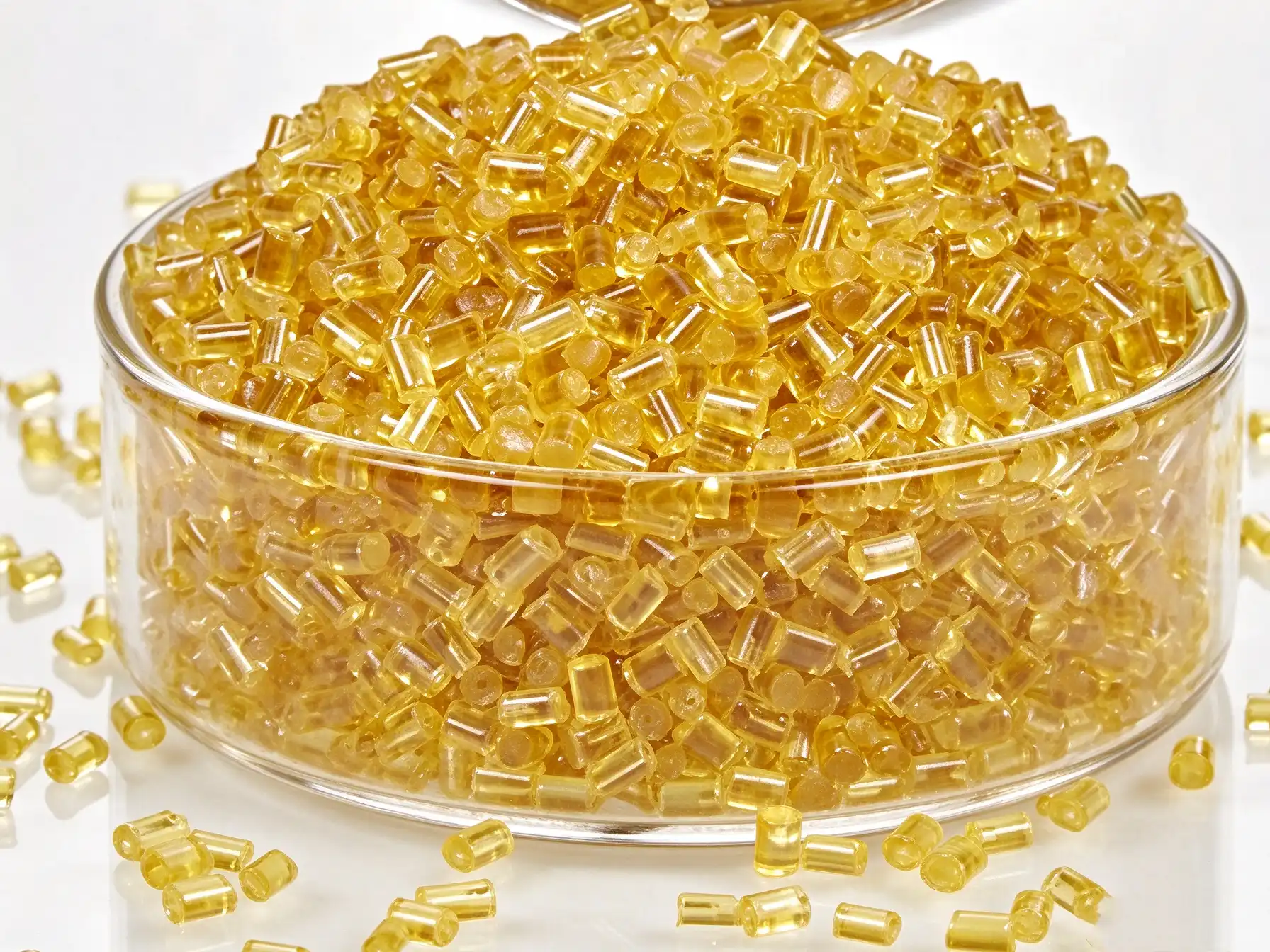
What the SABIC PEI HU1000 Data Sheet Actually Tells You
The SABIC PEI HU1000 data sheet describes an unreinforced amorphous polyetherimide with a glass transition temperature of 217°C — the defining figure for this Ultem HU1000 grade. Under a 1.8 MPa flexural load the heat deflection temperature is 192°C, rising to 209°C at 0.45 MPa; the Vicat softening point is 215°C and all three UL relative temperature index values sit at 170°C. Those figures place the resin well above polycarbonate — roughly forty degrees of headroom on Tg.
In our experience, though, the selection boundary for heat-resistant amorphous polymers is never the single highest number. Three scenarios decide most projects:
Repeated steam sterilization. At 134°C saturated steam, PC parts typically develop stress cracking or haze within dozens of cycles. The hydrolytic stability of PEI covers this range.
In-line cleaning and reflow exposure. Components that travel through CIP/SIP cycles or ride along reflow profiles see short peaks above 200°C.
Thin-wall rigidity. Amorphous polymers lose modulus continuously past Tg rather than dropping at a melt point. With a flexural modulus of 3300 MPa, tensile modulus of 3200 MPa, and 0.5–0.7% isotropic mold shrinkage, precision fit parts hold predictable dimensions.
The six rows of the data sheet that most often decide a quote, a yield rate, or an assembly tolerance:
| Property | Typical value | Test method | What purchasing should watch |
| Tensile stress at yield | 110 MPa | ISO 527 | Near PC levels, but failure modes differ — do not copy PC safety factors |
| Flexural modulus | 3300 MPa | ISO 178 | Basis for wall-thinning decisions on rigid parts |
| Notched Izod impact | 6 kJ/m² | ISO 180/1A | The row to read carefully: strong notch sensitivity |
| Heat deflection temp. | 192°C (1.8 MPa) | ISO 75/Af | Gate for steam sterilization and reflow survival |
| Water absorption | 0.25% (24h) / 1.25% (sat.) | ISO 62-1 | Drives drying cost and dimensional compensation |
| Melt volume rate | 13 cm³/10min (360°C/5kg) | ISO 1133 | Flow class for multi-cavity thin-wall fills |
The impact row is the one most often misread. Unnotched Izod is NB (no break) at both 23°C and -30°C, which looks generous; the notched value is only 6 kJ/m² and barely moves with temperature. From customer feedback, most PEI part failures trace back to sharp internal corners, weld lines, or aggressive ejection — not to insufficient material strength. Density is worth a second look as well: at 1.27 g/cm³, the same part runs roughly 6% heavier than in PC, and that difference compounds when quotes are compared per kilogram instead of per finished piece.
Biocompatibility and Compliance: ISO 10993, USP Class VI and the Document Chain
As a biocompatible polyetherimide, this medical grade PEI plastic is positioned for medical devices and pharmaceutical applications and is supported against ISO 10993 or USP Class VI. SABIC applies healthcare change management to this grade, which matters more than the certificates themselves: a formula lock means the supplier is obligated to notify customers when the recipe, source, or process changes. For teams managing device registrations, that notification obligation is the difference between a routine document update and an unplanned regulatory submission.
The wider compliance picture on the data sheet includes:
Food contact compliant in most jurisdictions, with a declaration available on request — note the caveat that exceptions exist.
RoHS compliance and no intentionally added PFAS, both of which increasingly appear in customer questionnaires and hospital procurement audits.
ISCC+ certified renewable bio-based solutions available under differentiated color nomenclature, relevant where sustainability reporting is part of the tender.
UL yellow card E121562-100044765 for flame ratings, with UL 94 V-0 recognized at 0.75 mm and 5VA at 3 mm.
One caution that runs through every sourcing case we handle: the data sheet states in its own footnotes that values are indicative for material selection only, not a specification and not a basis for part or tool design. Writing typical values into purchase-contract acceptance clauses is a recurring error, and it fails exactly when a batch sits slightly off typical but fully within spec.
A second caution covers flame ratings: UL recognition does not automatically extend to every thickness and every color. Thin-wall parts and colored variants need to be checked against the yellow card directly, ideally before tooling is cut.
Sterilization Compatibility: Six Methods, Three Trade-Offs
The data sheet states that Ultem HU1000 may offer resistance to steam, hydrogen peroxide, gamma, ethylene oxide, UV-C and electron beam for repeated sterilization cycles. That sentence is easy to read as "any method works." As a sterilizable medical thermoplastic, the real picture splits into three layers:
Chemical compatibility. Steam and hydrogen peroxide are hydrolytic and oxidative environments that test hydrolytic stability; EtO is a low-temperature process gentle to the polymer but slow on aeration residuals.
Cumulative radiation dose. Gamma and e-beam are ionizing. PEI tolerates radiation better than most transparent resins, but yellowing still develops at high cumulative doses. The natural color is transparent amber, so drift is invisible on dark parts and a visible defect on clear windows.
Validation cost. Changing the sterilization method is a change event under device regulations, often triggering renewed biocompatibility and performance testing. Sterilization method belongs upstream of material selection — frozen at design lock, not patched afterwards.
The practice we recommend, and the one that survives audits: put sterilization method, cycle count, and allowable property degradation into a single table and send it with the RFQ, asking the supplier to confirm against that operating envelope rather than answering with a general "sterilizable."
Custom Colors: What Medical Coloring Really Requires
Ultem HU1000 is supplied in its natural transparent amber, and the same grade is available in custom colors, both transparent and opaque, with color matching against PMS or RAL references. The recurring industry mistake is treating custom color Ultem HU1000 work as cosmetic — sending it to a general-purpose coloring house and starting production. Four gates separate medical coloring from ordinary coloring:
Carrier compatibility. The masterbatch carrier must survive the PEI processing window (melt temperature 350–410°C). Generic carriers decompose at those temperatures, bringing black specks and odor.
The compliance chain. Colorant components enter the biocompatibility assessment. ISO 10993 and USP Class VI conclusions attach to specific formulations; swap the colorant and the original conclusion does not carry over automatically.
Post-sterilization color drift. Gamma and e-beam fade or shift some organic pigments. Color development should include a before/after sterilization comparison, quantified with ΔE values rather than visual judgment.
Change management. For medical grades, formula lock and change notification are part of the registration file. A colorant substitution or origin change at the masterbatch supplier should trigger notification, and that obligation belongs in the contract.
Our sister company Qingdao Primetech Plastics works exactly at this intersection: an engineering-plastics modification and coloring provider covering PC, ABS, PP, PA, PBT, PPS, PPA and PETG, with toughening, filling, alloying (such as PC/ABS), flame retardance and coloring — including medical masterbatch. Standard colors and basic modifications run on a 3-day sample, 7-day delivery cycle, which shortens the validation loop considerably.

Sourcing and Processing: A Practical Checklist
Step one — collect the compliance pack. Request the technical data sheet, ISO 10993 or USP Class VI supporting statements, the UL yellow card (E121562-100044765 for this medical grade PEI), the RoHS declaration and the food-contact declaration.
Step two — audit the process window against your equipment. Drying at 150°C for 4–6 hours with maximum residual moisture of 0.02%; melt temperature 350–410°C; mold temperature 135–180°C. The PEI injection molding window decides whether the existing line can run at all: standard water tempering units cannot hold 135°C mold temperature, oil units are required, and barrel, screw and hot-runner components must tolerate 400°C-class residence.
Step three — validate on surrogate tooling. The data sheet itself recommends mold shrinkage studies for Ultem HU1000 with surrogate or legacy tooling before cutting new tools. Amorphous shrinkage is isotropic on paper, but real values still respond to geometry and process conditions.
Step four — fix the supply and trade structure. For imported medical grade PEI, lead-time volatility comes mostly from shipping and customs routing. Qingdao Prime Union Trade Co., Ltd. brings more than twenty years of plastics distribution experience as a first-tier distributor for Chi Mei, SABIC, Hanwha and Hyosung, carrying ABS, PC, PP, PMMA, EVA and other commodity and engineering resins, with four owned warehouses across China, routine stock on core grades, and general trade, processing-trade handbook and bonded re-export structures available. For medical customers, the tax and cash-flow difference between handbook and bonded re-export across prototype and volume phases is worth clarifying early.
Five recurring mistakes, in no particular order, from actual sourcing reviews:
Treating the technical data sheet as a specification and pasting typical values into contract acceptance clauses.
Ignoring the 24-hour cumulative drying cap, then chasing property loss in re-dried regrind.
Designing from PC notched-impact experience and leaving sharp corners in PEI parts.
Comparing price per kilogram only, without sterilization scrap rates and cycle yield — a higher-priced resin that survives three more sterilization cycles can win on cost per use.
Switching colorant or supplier after the regulatory dossier has been submitted, triggering change procedures that delay market entry.
Summary and Recommendation
Medical-grade PEI is not a "highest performance wins" choice; it is a "can all constraints be satisfied simultaneously" choice. The value of Ultem HU1000 resin is that SABIC combined 217°C glass transition, 0.5–0.7% stable shrinkage, inherently flame-retardant V-0 behavior and transparency in one grade — at the cost of notch sensitivity and a demanding processing window. The productive purchasing move is to close out sterilization method, color strategy, compliance documents and trade structure before design freeze, so that material parameters serve the registration path instead of forcing a material change after problems surface. Suppliers who can fill in that table early are the ones worth shortlisting.