 English
 Korean


The global optical grade polycarbonate market was valued at approximately USD 1.8 billion in 2024 and is projected to reach USD 3.9 billion by 2032, growing at a CAGR of 7.2%. This growth is driven primarily by the automotive lighting sector—over 78 million vehicles were produced globally in 2024, and manufacturers are increasingly adopting optical polycarbonate for headlamps, fog lights, and interior lighting applications. The material offers up to 90% light transmittance with minimal haze, making it a compelling alternative to glass where impact resistance and weight reduction are critical.
Within SABIC's extensive LEXAN portfolio, the 123R grade occupies a specific position: a low-viscosity, UV-stabilized polycarbonate resin designed for injection molding of complex, thin-walled optical components. For engineers and product designers working on LED lenses, automotive lighting, or transparent electronic housings, understanding the complete property profile of this material is essential for successful specification and processing. This article provides a data-driven examination of LEXAN 123R's optical, mechanical, and processing characteristics, drawing from official technical data sheets and industry sources.
Optical Properties: Light Transmission, Haze, and Refractive Index
For any optical application, the three non-negotiable parameters are light transmission, haze, and refractive index. LEXAN 123R delivers competitive performance across all three.
Light Transmission: At 2.54 mm thickness, LEXAN 123R achieves 88.0% to 90.0% total luminous transmittance per ASTM D1003. This places it at the higher end of the optical PC spectrum, suitable for applications where light output efficiency is paramount—LED secondary optics, display covers, and lighting lenses.
Haze: The material exhibits less than 0.8% haze at the same thickness. Low haze is critical for maintaining image clarity and minimizing light scattering. In precision optical systems, even 1% haze can reduce contrast and optical efficiency. LEXAN 123R's sub-0.8% specification ensures it meets the requirements of demanding visual applications.
Refractive Index: At 1.586 (ASTM D542 / ISO 489), LEXAN 123R matches the standard refractive index of bisphenol-A polycarbonate. This is a critical design parameter: optical engineers can design lenses and light guides using standard PC optical models without needing to compensate for refractive index variations. For context, other optical PC grades such as Makrolon® 3206 and CALIBRE™ 303-10 also report 1.586, confirming that LEXAN 123R is within the industry norm for unmodified optical PC.
From our experience supporting optical-component manufacturers, we've observed that the combination of >88% transmission and <0.8% haze is the baseline threshold for Tier 1 suppliers. Grades falling below these figures typically require design compromises or secondary surface treatments to achieve acceptable optical performance.
Mechanical Performance: Impact Strength and Modulus
Optical components must survive real-world mechanical stresses—vibration, thermal cycling, and occasional impact—without fracturing or losing optical alignment. LEXAN 123R's mechanical properties reflect polycarbonate's inherent toughness.
Tensile Properties: Yield tensile strength is 62–63 MPa with a yield elongation of approximately 6–7%. Break tensile strength reaches 65 MPa with elongation at break of 100–110%. This combination indicates a ductile material that yields before breaking, providing visible warning of overload rather than sudden brittle failure.
Flexural Modulus: At 2,300–2,340 MPa, the material offers moderate stiffness—sufficient for thin-walled housings and lens mounts without being overly rigid. This balance is advantageous for components that experience thermal expansion mismatches with metal inserts or housings.
Impact Strength: Notched Izod impact strength at 23°C is 65 kJ/m² (ISO 180/1A) or approximately 694–735 J/m (ASTM D256). Unnotched specimens do not break at 23°C, indicating exceptional toughness. Even at -30°C, notched impact strength remains at 11 kJ/m²—a critical parameter for automotive applications exposed to winter conditions.
These mechanical properties make LEXAN 123R suitable for applications ranging from automotive interior lenses (where impact resistance from passenger contact is a concern) to handheld device windows (where drop resistance is required).
Thermal and Electrical Properties
While optical and mechanical properties often dominate material selection discussions, thermal and electrical characteristics determine long-term reliability in service.
Heat Deflection Temperature (HDT): At 0.45 MPa (unannealed, 6.4 mm), HDT is 137°C. At 1.82 MPa, it is approximately 132°C. This thermal capability allows LEXAN 123R to withstand the operating temperatures of automotive lighting systems (where LED drivers and nearby electronics generate significant heat) and consumer electronics enclosures.
Vicat Softening Temperature: 140–154°C depending on test method. This provides a margin of safety for applications requiring short-term exposure to elevated temperatures during soldering or reflow processes.
Relative Thermal Index (RTI): Rated at 130°C for electrical, mechanical, and impact properties. This UL-recognized rating confirms the material's long-term thermal stability under continuous use conditions.
Electrical Properties: Volume resistivity exceeds 1×10¹⁵ Ω·cm, and dielectric strength is approximately 17 kV/mm (at 3.2 mm in oil). These properties make LEXAN 123R suitable for electronic housings and connector applications where electrical insulation is required.
For engineers designing LED lighting systems, the combination of 137°C HDT and 130°C RTI provides confidence that the lens material will maintain dimensional stability and optical clarity over the product's service life, even in enclosed luminaires where heat buildup is common.
Processing Guidelines: Achieving Optical Quality
LEXAN 123R is classified as a low-viscosity grade with a Melt Volume Rate (MVR) of 21 cm³/10 min at 300°C / 1.2 kg and a corresponding Melt Flow Rate (MFR) of approximately 17.5–18 g/10 min. This high flowability is specifically designed for filling complex, thin-walled molds—exactly the type of geometries found in optical lenses, light guides, and miniature electronic components.
However, achieving optical-grade clarity requires strict adherence to processing parameters. Even minor deviations can introduce haze, birefringence, or surface defects that compromise optical performance.
Drying: 120°C for 2–4 hours, with a maximum recommended moisture content of 0.02%. Polycarbonate is hygroscopic, and moisture above 0.02% causes hydrolysis during melt processing, resulting in silver streaks, bubbles, and reduced molecular weight. In our experience supporting injection molders, inadequate drying is the single most common cause of optical defects in PC lenses.
Melt Temperature: 280–305°C. The nozzle should be set to 270–300°C, with rear zone at 260–280°C, middle at 270–295°C, and front at 280–300°C.
Mold Temperature: 70–100°C. Higher mold temperatures (approaching 100°C) improve surface replication of optical features and reduce internal stresses that can cause birefringence. However, they also extend cycle times—a trade-off that must be evaluated based on the component's optical requirements.
Screw Speed: 40–70 rpm with back pressure of 0.3–0.7 MPa. Excessive screw speed generates frictional heat and can degrade the polymer, while insufficient back pressure may result in inconsistent melt homogeneity.
Key Insight: The difference between an acceptable optical part and a reject is often measured in single-digit temperature degrees or fractions of a percent moisture. We recommend implementing in-line moisture analyzers for high-volume optical production and validating mold filling simulations against actual short-shot studies before committing to production tooling.
Flame Rating and UV Stability
Flame Classification: LEXAN 123R achieves UL94 HB rating at 0.75 mm and 3.0 mm. HB (Horizontal Burn) is the baseline flammability rating, indicating the material will burn slowly when exposed to flame but is not self-extinguishing. For applications requiring V-0 or V-2 ratings, SABIC offers other LEXAN grades within the 200 series and FR series.
UV Stability: The material is UV-stabilized and carries a UL-746C f1 rating. The f1 designation confirms suitability for outdoor exposure—a critical requirement for automotive exterior lighting, solar components, and outdoor signage. Without UV stabilization, polycarbonate undergoes photo-oxidation leading to yellowing, surface crazing, and loss of impact strength.
Oxygen Index (LOI): 25%—indicating the minimum oxygen concentration required to sustain combustion. This is typical for unmodified polycarbonate.
Glow Wire Flammability Index (GWFI): 850°C at 1.0 mm (IEC 60695-2-12). This is relevant for electrical applications where components may be exposed to abnormal heat from overloaded circuits.
For engineers specifying materials for automotive lighting, the combination of UV stability (f1) and HB flame rating at 0.75 mm is often sufficient for lens applications, as the lens is not typically the primary flame barrier—that role falls to the housing. However, always verify with your specific application's regulatory requirements.
Typical Applications and Industry Use Cases
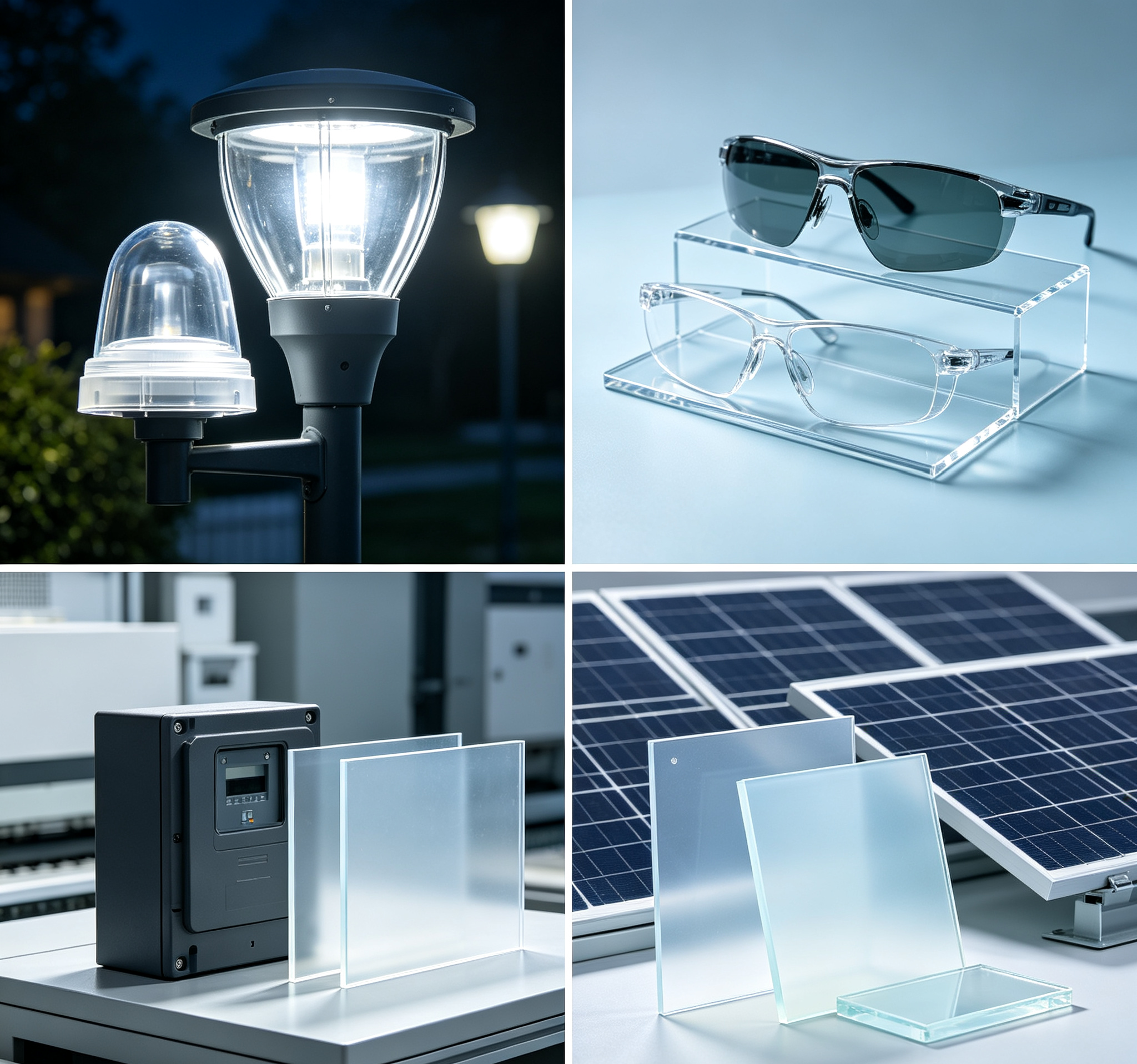
Based on the property profile and SABIC's application guidance, LEXAN 123R is specified across multiple industries:
Automotive
LED headlamp lenses and light guides
Fog light covers and interior lighting lenses
Dashboard instrument cluster covers
Window encapsulation and interior trim components
Consumer Electronics
Smartphone camera lens covers
Display windows and transparent housings
AR/VR device optical elements
Telecommunications component housings
Lighting
LED secondary optics and collimators
Light diffusers and protective covers
Outdoor luminaire lenses (UV-stabilized)
Industrial
Medical device components (lens, housings)
Aerospace interior lighting
Outdoor equipment displays and gauges
The material's low viscosity makes it particularly suitable for miniaturized and complex geometries where high flow is essential to fill thin sections without excessive injection pressure. The built-in mold release additive further enhances processing by reducing ejection forces and minimizing surface blemishes from ejector pins.
One area of growing interest is solar energy applications. Optical polycarbonate is increasingly used in concentrated photovoltaic systems and solar panel protective covers due to its weatherability and light transmission efficiency. With solar capacity installations growing at approximately 12% annually, these niche applications could become significant demand drivers by 2032.
Conclusion
SABIC LEXAN™ 123R is a well-characterized optical grade polycarbonate that balances high light transmission (>88%), low haze (<0.8%), and a refractive index of 1.586 with the mechanical toughness and thermal stability expected of the polycarbonate family. Its low-viscosity (MVR 21) formulation enables filling of complex, thin-walled optical geometries, while UV stabilization (UL-746C f1) and UL94 HB rating at 0.75 mm provide the regulatory compliance needed for automotive, consumer electronics, and lighting applications.
For engineers and product designers evaluating optical PC grades, the critical success factors are not just the datasheet values but the processing discipline required to achieve them—particularly drying to ≤0.02% moisture and maintaining melt temperatures within the 280–305°C window. With the optical grade polycarbonate market projected to nearly double by 2032, materials like LEXAN 123R will continue to play a central role in the transition from glass to lightweight, impact-resistant polymer optics across multiple industries.
Get Expert Support
For procurement and application support, Qingdao Prime Union Trade Co., Ltd. offers direct supply access to LEXAN 123R and maintains ready inventory across four regional warehouses in China, supporting general trade, processing trade, and bonded transfer logistics. Its sister company, Qingdao Primetech Plastics Co., Ltd., provides in-house modification and color compounding services—including toughening, alloying (PC/ABS), flame retardancy, and custom coloring—with sample delivery in 3 days for standard colors and production within 7 days. All samples are chargeable, but the cost is deductible against future bulk orders. This integrated supply-and-modification model is built on two decades of hands-on experience in engineering plastics, offering engineers a reliable path from material selection to production-ready components.