
 English
 Korean


The global automotive lighting polycarbonate market was valued at approximately $1.046 billion in 2025 and is projected to reach $1.609 billion by 2032, growing at a CAGR of 6.4%. This growth is driven by the rapid transition from halogen to LED matrix and adaptive pixel lighting systems, which demand thinner wall sections (1.2–2.5 mm) and increasingly complex geometries. For lighting design engineers, this translates to a critical material selection challenge: finding a polycarbonate grade that balances flowability for thin-wall filling with optical clarity, thermal stability, and long-term weatherability. Makrolon® AL2447 low viscosity polycarbonate from Covestro addresses this exact requirement. With a melt volume-flow rate (MVR) of 19 cm³/10 min at 300°C/1.2 kg, this UV-stabilized grade is engineered specifically for headlamp lenses and automotive forward lighting applications. This article examines the material's rheological behavior, optical durability, thermal performance, and modification potential—providing design engineers with the technical data needed for informed material selection.
Rheological Behavior and Thin-Wall Fill Capability
MVR is the primary indicator of a polycarbonate grade's flow characteristics under injection molding conditions. Makrolon® AL2447 low viscosity polycarbonate delivers an MVR of 19 cm³/10 min (300°C/1.2 kg) and a corresponding melt mass-flow rate (MFR) of 20 g/10 min. This places it in the low-viscosity category within Covestro's Makrolon portfolio. In thin-wall lens applications where fill times are typically under one second and shear rates reach 10⁴–10⁵ s⁻¹, this enhanced flowability allows the melt to fill longer flow paths and thinner nominal wall sections compared to standard-viscosity grades.
| Rheological Property | Test Condition | Typical Value | Unit | Standard |
|---|---|---|---|---|
| MVR | 300°C/1.2 kg | 19 | cm³/10min | ISO 1133-1 |
| MFR | 300°C/1.2 kg | 20 | g/10min | ISO 1133-1 |
| Molding Shrinkage, Parallel | 60×60×2 mm, 500 bar | 0.65 | % | ISO 294-4 |
| Molding Shrinkage, Normal | 60×60×2 mm, 500 bar | 0.70 | % | ISO 294-4 |
From a practical molding perspective, the lower viscosity translates to reduced injection pressure requirements for the same fill length. For a lens with a flow length-to-wall thickness ratio exceeding 150:1, AL2447 can achieve fill lengths approximately 12–15% longer than standard PC grades under identical pressure conditions. However, this improved flowability comes with increased sensitivity to packing parameters. The shrinkage values (0.65% parallel, 0.70% normal) are measured on standard 60×60×2 mm plaques at 500 bar and serve as reference points only. Actual part shrinkage can vary by 0.1–0.2% depending on gate design, wall thickness distribution, and packing profiles—factors that must be accounted for during the mold design phase.
The tensile modulus of 2,400 MPa and yield stress of 66 MPa at 23°C provide the structural integrity required for lens mounting features. Design engineers should note that the tensile creep modulus decreases from 2,200 MPa at 1 hour to 1,900 MPa at 1,000 hours—a 14% reduction that must be considered when designing snap-fit or screw boss features that experience sustained loads over the vehicle's service life.
Optical Performance and UV Stabilization System
Automotive headlamp lenses require initial light transmittance of at least 88% with a yellowing index (YI) below 2. Makrolon® AL2447 low viscosity polycarbonate achieves 89–91% light transmittance at 3 mm thickness with haze below 0.5%, meeting the optical entry requirements for exterior lighting applications. The UV stabilization package is designed to absorb ultraviolet radiation in the 340–380 nm range, retarding photo-oxidative chain scission and chromophore formation that would otherwise lead to yellowing and haze development.
| Optical & Electrical Property | Test Condition | Typical Value | Unit | Standard |
|---|---|---|---|---|
| Light Transmittance | 3 mm thickness | 89–91 | % | — |
| Relative Permittivity | 100 Hz / 1 MHz | 3.1 / 3.0 | — | IEC 60250 |
| Volume Resistivity | — | 1×10¹⁴ | Ω·m | IEC 62631-3-1 |
| Electric Strength | 1 mm | 34 | kV/mm | IEC 60243-1 |
| CTI | Solution A | 250 | V | IEC 60112 |
Based on Covestro's internal accelerated weathering testing per SAE J2527 (0.55 W/m² at 340 nm, 70°C black panel temperature), AL2447 maintains over 92% light transmittance retention after 2,000 hours of exposure, with a yellowing index increase (ΔYI) of less than 3. This performance is attributed to the combination of high-purity base resin and a synergistic stabilizer system. However, UV protection efficiency is thickness-dependent. In lens sections exceeding 3.5 mm, the unabsorbed UV radiation in the interior regions can still initiate photodegradation. For this reason, we recommend independent weathering validation on the thickest sections of the actual lens geometry rather than relying solely on standard plaque data.
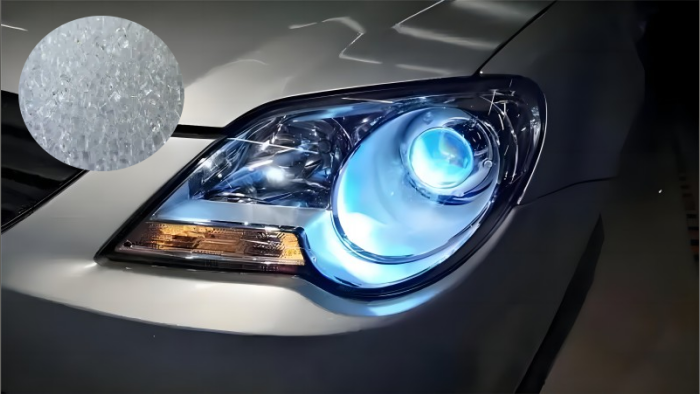
One frequently overlooked optical defect is surface haze or "orange peel" caused by moisture-induced hydrolysis during processing. Polycarbonate is hygroscopic; pellets absorb moisture during transportation and storage. If residual moisture exceeds 0.02% prior to injection molding, hydrolytic degradation generates low-molecular-weight species that can outgas and deposit on the mold surface, creating optical imperfections. This failure mode is process-controlled and requires rigorous drying discipline, which we address in the processing section below.
Thermal Performance and Long-Term Reliability
LED light sources typically operate at junction temperatures of 110–140°C, and under solar loading, the internal lens surface temperature can exceed 105°C. Makrolon® AL2447 low viscosity polycarbonate demonstrates the following short-term thermal characteristics:
| Thermal Property | Test Condition | Typical Value | Unit | Standard |
|---|---|---|---|---|
| HDT | 1.80 MPa | 125 | °C | ISO 75-1,-2 |
| HDT | 0.45 MPa | 138 | °C | ISO 75-1,-2 |
| Vicat Softening Temp | 50 N, 50°C/h | 144 | °C | ISO 306 |
| Vicat Softening Temp | 50 N, 120°C/h | 145 | °C | ISO 306 |
| Glass Transition Temp | 10°C/min | 145 | °C | ISO 11357 |
| CLTE, Parallel/Normal | 23–55°C | 0.65×10⁻⁴ | 1/K | ISO 11359 |
These short-term thermal indicators meet conventional automotive lighting requirements. However, long-term thermal aging performance is better assessed using UL 746B Relative Thermal Index (RTI) values. At 1.5 mm thickness, AL2447 exhibits RTI values of 115°C for tensile impact strength and 125°C for both tensile strength and electric strength. This means that if the lens operating temperature consistently exceeds 115°C—as may occur in tropical climates within sealed lamp housings—the material's impact toughness will accelerate its degradation rate, potentially compromising stone-chip resistance or mounting feature integrity.
The coefficient of linear thermal expansion (CLTE) is 0.65×10⁻⁴/K in both parallel and normal directions. This isotropic expansion behavior simplifies thermal stress calculations in lens assemblies where the optic is mounted to metal or plastic bezels with different expansion coefficients. The puncture impact behavior shows maximum forces of 5,100 N at 23°C and 6,000 N at -30°C, with puncture energies of 55 J and 65 J respectively—the increase at low temperature is noteworthy and beneficial for cold-climate impact resistance.
For design engineers performing structural simulations, we recommend using the long-term creep modulus of 1,900 MPa (1,000 hours) rather than the instantaneous tensile modulus of 2,400 MPa when evaluating snap-fit retention or screw boss creep over the vehicle's lifetime.
Processing Window and Critical Control Parameters
Polycarbonate is highly sensitive to moisture, and Makrolon® AL2447 low viscosity polycarbonate is no exception. Inadequate drying is the leading cause of splay, bubbles, molecular weight degradation, and optical property loss in production lenses. Based on Covestro's processing guidelines for automotive lenses, the following parameters serve as a starting point:
| Processing Parameter | Recommended Range | Notes |
|---|---|---|
| Drying Temperature | 120°C | Desiccant-type dryer required |
| Drying Time | 4 hours | Dew point < -20°F |
| Max. Moisture Content | ≤0.02% | Critical quality parameter |
| Melt Temperature | 280–320°C | Standard: 300°C |
| Mold Temperature | 70–110°C | Higher for high-gloss optics |
| Hold Pressure | 50–75% of injection pressure | DOE optimization recommended |
| Peripheral Screw Speed | 0.05–0.2 m/s | Avoid shear overheating |
| Vent Depth | 0.025–0.075 mm | Critical for optical surfaces |
Splay and silver streaks are the most common cosmetic defects in PC lenses, and in our experience supplying the automotive sector, the root cause is almost always insufficient drying time or desiccant bed saturation. We recommend monitoring dew point every two hours during production and regularly calibrating the drying hopper temperature uniformity. When melt temperature exceeds 315°C, thermal degradation generates phenolic oligomers that can corrode mold coatings and shorten polishing cycles—sustained high-temperature operation should be avoided.
Mold temperature has a direct impact on residual stress and optical birefringence. Mold temperatures below 80°C produce thicker frozen layers and higher internal stresses, which not only affect dimensional stability during assembly but also accelerate stress cracking in service. For exterior headlamp lenses, we recommend setting mold temperature in the 100–110°C range and validating the process using polarized light stress inspection to verify birefringence distribution. Lenses with complex geometries—including screw bosses, ribs, locator features, and molded-in lettering—will require further refinements to the filling speed profile to eliminate cosmetic defects.
Custom Modification and Color Compounding Support
While standard AL2447 is available in clear transparent and various signal colors, lighting projects often require precise color matching (e.g., specific color temperatures for light guides, red tail lamp covers) or additional functional modifications such as improved heat resistance, enhanced flame retardancy, or better surface scratch resistance. In these cases, secondary modification or color compounding based on the PC base resin is a common engineering pathway.
Resources Diversification
Our affiliate, Qingdao Primetech Plastics Co., Ltd., specializes in engineering plastics modification and color compounding, covering PC, ABS, PP, PA, PBT, PPS, PPA, PETG, and other material systems. For PC-based products, modification capabilities include toughening, filling, alloying (e.g., PC/ABS), flame retardancy, and custom coloring—even extending to medical-grade masterbatch production.
Rapid Response
Based on customer feedback from actual projects, the most valued capability is response speed. Primetech offers sample production completion in 3 working days and bulk order completion in 7 working days, ready for shipment — a timeline that effectively supports the rapid prototyping and validation cycles common in automotive lighting development.
It should be noted that modified or color-compounded materials can exhibit changes in optical performance due to additive type and loading. For example, certain pigments may reduce light transmittance or interfere with UV stabilization. Therefore, Primetech provides corresponding performance test reports with each sample delivery, including light transmittance, color difference, impact strength, and other critical metrics—enabling direct comparison between the base resin and modified variants. All samples are provided on a fee basis, with sample fees creditable against subsequent bulk orders, a flexible arrangement for project-stage evaluations.
For design engineers and procurement professionals seeking more sustainable options, Covestro also offers Makrolon® AL2447 RE—a partially bio-circular grade attributed via mass balance in accordance with the ISCC PLUS standard—as well as AL2447 RP70 CQ with post-consumer chemically recycled attributed content. These drop-in solutions provide identical performance to the standard grade while supporting sustainability goals.
Conclusion
Makrolon® AL2447 low viscosity polycarbonate delivers a well-balanced combination of flowability, optical durability, thermal stability, and dimensional precision for automotive lighting applications. For design engineers evaluating this material, we recommend:
integrating MVR data with mold flow analysis to establish appropriate fill velocity profiles;
treating moisture content as a critical process parameter with continuous monitoring;
using the long-term creep modulus (1,900 MPa) rather than instantaneous values for structural simulations; and
validating the RTI limits against actual lens wall thickness and thermal field distribution.
As authorized distributors for Chimei, Hyosung, Hanwha Total, and with direct cooperation with Covestro, Qingdao Prime Union Trade Co., Ltd. ensures a stable, reliable supply of Makrolon® AL2447.
In synergy, our affiliate Qingdao Primetech Plastics Co., Ltd. extends this foundation with modification, coloring, and alloying capabilities—delivering a complete material solution, from base resin to tailored compounds, for the automotive lighting industry.

References
Covestro AG. Makrolon® AL2447 Product Datasheet. 2024.
Covestro AG. Processing Information for Automotive Lenses (Technical Report COV-206). 2019.